
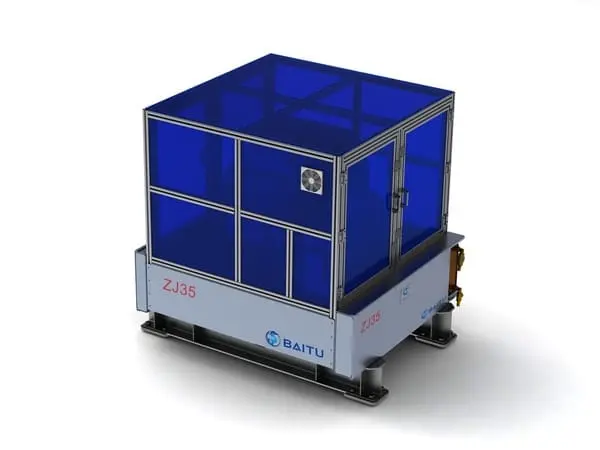
ZJ 35

Eco-friendly, reliable, and self-cooling stabilizers – Electro-mechanical design eliminates oil leakage risk, offers up to 6,000 hours of fault-free operation, and uses recycled electricity for instant cooling after docking.
ZJ 35

Technical Specifications

Model ZJ 35
Hull Length ≤ 30 m / 98.4 ft
Full Load Displacement ≤ 105 tons
Rated RPM 3,000 RPM
Angular Momentum 35 kNms
Anti-rolling Torque 105 kNm
Time to Rated RPM 40 minutes
Time to Stabilization 20 minutes
Start-up Power 0.4~12 kW
Operating Power 7~11 kW
Power Input 3PH AC380V 12 kW
Weight 2,020 kg / 4,453.3 lbs
Overall Size(L*W*H)
Metric(meter) 1.15 × 1.50 × 1.34
Imperial(inch) 45.3 × 59.1 × 52.8
Installation Space(L*W*H)
Metric(meter) 1.35 × 2.30 × 1.44
Imperial(inch) 53.1 × 90.6 × 56.7
Cooling Method Raw Water-cooled 15 L/min
Ambient Temperature −20℃ ~ 60℃
Noise Output@1 meter ≤ 73 dB
Protection Rating IP65
Control Panel 5-inch Touch Screen

Installation — Simple, Flexible, Cost-Efficient

Flexible placement
- Mount at bow / midship / stern; centered or offset; upright or inverted — same roll-reduction (subject to on-site space & foundation strength).
- Prioritize rigid zones (e.g., spanning two longitudinals; areas bounded by frames/bulkheads fore & aft) to diffuse alternating torque into the hull.
Compact space requirement
- Small hatch: ZJ2/ZJ4 from 610 × 780 mm (split-lift supported; larger models per spec).
- Clearances: sides 100–400 mm (service); underside 200–500 mm net.
- Ventilation: ambient ≤ 45 °C → natural; otherwise add a small fan (~300 m³/h).
- Rigidly fasten the unit; only minimal free space is required around the base.
Short installation time
- Typical 1–2 days end-to-end; no special tools; supports remote guidance.
- Fits newbuilds and refits; split-lift lowers retrofit cost and enhances vessel value.
Foundation & fastening
- Base flatness ≤ 0.5–1.5 mm.
- High-strength bolts with Loctite 243; torque 80–1,000 Nm (model-dependent).
- FRP hulls: embedded steel plates + glass-fiber reinforcement.
- Steel/Aluminum hulls: welded base frame.
- Commodity materials; no specialized welding crew required.
Cooling, power & lines
- Raw-water (outer loop): external seawater pump (recommend SEAFLO 24 V, 5–17 L/min, cost-effective).
- Closed loop (inner): automotive antifreeze, −25 °C grade.
- Power: dedicated breaker (from 16 A); shielded cable to touchscreen.
- Filtration: seawater strainer 20–100 mesh, easy to service.
Standard 6-step installation
1) Verify foundation: hole pattern & flatness; parallel to vessel centerline.
2) Lift & place: set vibration pads; use flywheel inner eyebolts; align; tighten.
3) Outer cooling: connect strainer → pump → cooler (bottom-in / top-out); leak check.
4) Electrical: route power/ground; confirm DC bus 310–560 V.
5) Inner coolant: fill to ≥ 90%; vent air; confirm no leaks.
6) Final checks: fasteners, cable routing, clearances; remove debris; remove lifting eyes.

Operation — One-Touch, Smart & Efficient

Quick effect & low power
- Intuitive touchscreen; one-button start/stop with live parameters.
- Noticeable roll reduction in ~15–30 min after start.
- Optimized for Sea State 3 (higher levels configurable).
- Low running power; a minor share of onboard energy use.
Start-up (5–10 min prep)
1) Routine check (monthly / pre-start): cables/grounding; hoses/strainer; bolts/foundation; antifreeze ≥ 80% (quick visual).
2) Power on: close breaker; HMI self-check ~10 s; acknowledge non-critical alerts.
3) Start: press Start/Stop → status Starting; at ≥ 50% speed → Stabilizing.
4) Monitor: bus voltage, temperatures, current — automatic control within normal ranges.
5) Smart Modes:
    - Speed Mode — Effect-first response for maximum roll reduction.
    - Smart Mode — Energy-saving auto-tuning to sea state and load.
Shutdown
- Normal: press Start/Stop → Stopping; flywheel coasts down ~90–120 min.
- Emergency: power-off is non-destructive; advisable when speed ≤ 50%.
Ease-of-use highlights
- No special skills required; friendly HMI.
- Low operating cost; rapid response to sea state; boosts comfort and reduces seasickness/incident risk.

Maintenance — DIY-Friendly, Long-Term Reliable

Routine checks (monthly / pre-start, 5–10 min)
- Cables/grounding & hoses/strainer: no leaks/clogs.
- Bolts/foundation: no looseness/rust; drag chain/hoses intact.
- Antifreeze ≥ 80% (top up with automotive coolant).
Minor maintenance schedule
Item Interval Notes
Antifreeze top-up Monthly Maintain ~90%; if < 60%, locate/repair leaks (user-serviceable).
Anode (zinc) Every 6 months Replace rod below inlet tee (simple tools; low-cost spare).
Water-cooling assembly Every 12 months Includes valve/anode; refill & recheck (standardized parts).
Flywheel vacuum + helium (models ≤ ZJ20) Every 12 months Vacuum-charge-seal under remote guidance.
Grease service (models > ZJ20) Every 100–500 h Bearings/geartrain with specified grease (e.g., SKF LGHP 2).
Gearbox grease replacement (all models) Every 2000 h MOLYWHITE RE No.00; add if noise increases.
Major service (condition-based, ~2000 h / 24 months)
- Replace aged hoses/cables/bearings if symptoms (abnormal noise/high vibration).
- Check cooler for perforation (air/water test); flush with fresh water to mitigate corrosion.

Warranty — 2 Years / 2,000 Hours

All Baitugyro products include a two-year / 2,000-hour full-system warranty for dependable support and peace of mind.

Contact Us

Have any questions or need more information? Please fill out the form below and we'll get back to you as soon as possible.

Contact form

Send us a message if you have any questions or request a quote. Our experts will give you a reply within 48 working hours and help you select the right products you want.